Date: 15 October 2026
Important Information: For professional clients only (FCA COBS 3). Not for distribution to retail clients. Capital at risk: the value of gold and bitcoin can fall sharply, and you could lose all of the money invested in bitcoin. Bitcoin-linked investments are high risk and are not covered by the Financial Services Compensation Scheme. This document is general information, not advice or a recommendation.
Gold has a long history as money and has been the debasement hedge of choice for many investors. Bitcoin's claim is that it can now perform the same role in a digital economy.
Though it is generally agreed that both gold and bitcoin are bets against fiat debasement, they are not the same. In fact, it is their differences that may make them a compelling pairing. In this article we set out the case for each, how they compare, and what to consider before holding either.
Their 30-day correlation has averaged 0.1 since 2014. Bitcoin has historically been about four times as volatile as gold, though in 2026 the gap narrowed sharply to be nearly matching. Low correlation is why some investors hold both, risk-balanced, rather than choosing one.
The case for gold
Gold is a 5,000-year-old store of value. Its case rests on four things:
- Debasement hedge. Supply grows about 1.5–2% a year from mining, far slower than fiat money supply. When real interest rates fall or governments run large deficits, gold has tended to gain in fiat terms, as seen over the last two years.
- Crisis asset. Gold has tended to hold up or rise in equity drawdowns, banking stress and geopolitical shocks, which is where a diversifier earns its keep.
- Central-bank demand. Central banks have bought over 1,000 tonnes a year since 2022, much of it from reserve managers diversifying away from US dollar assets after the 2022 freezing of Russia's reserves.
- Deep, regulated market. Gold trades around the clock in London, New York and Shanghai, with physically backed ETFs, futures and bars widely available. It is the trusted store-of-value asset, with a deep pedigree.
The drawbacks: gold has historically had long flat spells (roughly 1980–2001 and 2011–2019 in real terms), and costs money to store and insure. It is also difficult to use in transactions and is subject to a major supply shock (a new gold discovery that exceeds the c1.5-2% historical trend). Direct ownership of is impractical for many investors and allocations through funds, derivatives, custodians or other intermediaries introduces counterparty, custody and operational risks.
The case for bitcoin
Bitcoin is a 17-year-old digital bearer asset with a hard cap of 21 million coins. Its case is partly the gold case moved online, plus an adoption story:
- Fixed, known supply. Issuance halves every four years; since the April 2024 halving new supply has run below 1% a year, under gold's rate, and is trending to absolute scarcity.
- Portable and verifiable. It moves globally in minutes, can be self-custodied, and every holding can be audited on a public ledger.
- Adoption still early (a pro and a con). Bitcoin is an emerging store-of-value asset with adoption upside. US spot ETFs launched in January 2024 and now hold over a million coins; pensions, wealth platforms and some corporates are still building positions. If bitcoin takes even a fraction of gold's market value, the upside is large. Downside risk, including a fall to zero, must be considered along side.
The drawbacks: drawdowns of 75–85% have happened three times, its history is short, regulation is still developing, and in risk-off selloffs it has often traded like a high-beta technology stock rather than a haven. Depending on how exposure is obtained, additional risks may include loss of private keys, custody or platform failure, fraud, cyberattack, market manipulation, limited liquidity, tracking error, leverage, tax uncertainty, regulatory change and the credit risk of an issuer or product provider. Regulatory and compensation protections differ materially between direct cryptoasset holdings and regulated investment products.
Similarities and differences
Both are scarce, non-yielding assets used by some investors as a hedge against fiat debasement, but neither is assured to preserve value. Gold is established and widely held. Bitcoin is newer and may offer lower storage costs and faster transferability in some circumstances, but it remains on an uncertain adoption path and has a more viable route to becoming worthless than gold. Comparisons depend on the form of ownership: direct holdings, exchange-traded products, funds and derivatives have materially different fees, liquidity, custody, counterparty, regulatory and tax characteristics.
Bitcoin has historically been the more volatile asset, with larger drawdowns and spikes in volatility. At times it has traded like a technology stock, testing the patience of investors who have held it as a debasement asset. Gold, by contrast, has historically had low-volatility, although the rise in price in the last two years has come with increased volatility.
Gold's market value is roughly 17 times bitcoin's (gold at $4,150/oz on about 216,000 tonnes above ground, around $29tn, against bitcoin at $85,000 on 19.9 million coins, around $1.7tn), although bitcoin has been making headway.
Gold is the non-fiat currency asset held by central banks around the world. For centuries gold was money itself, and it is deeply entrenched as a monetary store or value asset. Whilst some central banks have begun to investigate bitcoin, it does not currently have comparable status at the central banks.
The two have been only loosely linked: their 30-day correlation averaged 0.1 over 12 years and was positive in 68% of months (charts below).
Correlation: 30-day, monthly since 2014
The two assets have mostly moved independently, but 2026 is the exception. Correlation reached 0.6 at end-September, the highest month-end reading in 12 years.
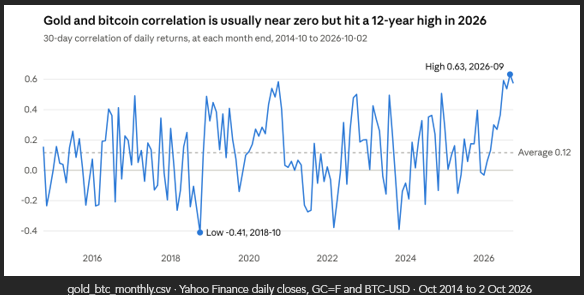
Each point is the correlation of daily log returns over the 30 trading days to that month end. Single months above 0.4 are common; sustained runs are not. There have been two: July–November 2020, after pandemic money-printing, and July 2026 to now.
Volatility: 30-day annualised, same period
Bitcoin has averaged 59% annualised volatility against gold's 15.5%, but the gap has closed.
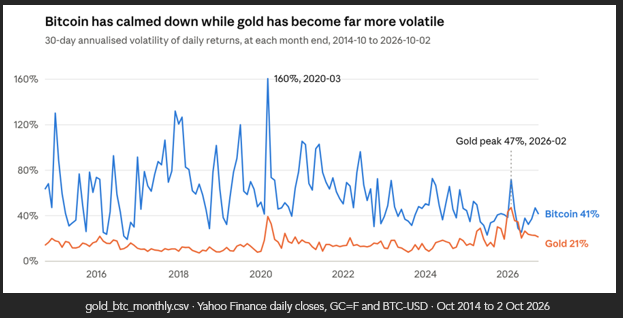
Bitcoin's yearly average volatility fell from 82% in 2017 to 39% in 2025 as ETF and institutional money deepened the market. Gold went the other way, from about 10% in 2017–19 to a 47% peak in February 2026 after its January surge to $5,318/oz and an 11% one-day fall. On 16 trading days this year gold was the more volatile of the two. Whilst that is not a huge amount of days, bitcoin is known as a highly volatile asset and gold as a low volatility asset so this closing of the volatility gap is worth watching.
Bitcoin only, gold only, or both?
Why bitcoin only? You believe it will take a large share of gold's store-of-value market and want the full upside. You can stomach 70–80% drawdowns and size the position so a wipe-out is survivable. Holding gold alongside it would dilute returns in the scenario you are betting on.
Why gold only? You want an asset with a long history through wars, inflation and banking crises, and which is held by central banks. Gold has sometimes been defensive during equity falls, but it has not risen in every drawdown and can itself experience prolonged losses or flat returns.
Why both? Either as two holdings you rebalance yourself, or through a single product that does it for you:
Spreading the exposure. The two could both benefit in some scenarios involving fiat debasement but either one could succeed to the detriment of the other. Having a stake in both covers all bases in the absence of a strong conviction for either asset.
- Diversification can smooth returns but isn’t guaranteed. The historic correlation near 0.1 indicates that the two assets have not moved closely together in price historically. However, correlation is unstable (see recent peak at 0.6) and there is no guarantee that the diversification benefit returns in future years.
- Bitcoin and gold can be combined in a single fund, incorporating rebalancing, for easy access for investors, or managed as two single allocations.
The trade-off: a blend will lag pure bitcoin in its best years and pure gold in a crisis where bitcoin falls, and, depending on the route, may carry rebalancing or product fees on top of the underlying holdings.
What to do with this
None of these options is right for every portfolio. The question is how each would fit your objectives, time horizon, risk budget and existing holdings. And whether a small allocation would act as a diversifier or simply add risk you do not need. Bitcoin, in particular, should only be considered by investors who can absorb a total loss on the position and hold through a sharp fall.
If you would like to explore this further, please speak to your usual Cartwright consultant, who can explain the available implementation routes, their regulatory status, material risks, costs, charges, conflicts and due diligence before any decision is taken. There is no charge for the initial conversation and no obligation to proceed; charges may apply if you later use an advisory, arrangement or investment service and will be disclosed before you commit.
Data and sources
Charts use daily closes from Yahoo Finance: COMEX gold futures (GC=F, USD/oz) and BTC-USD. The sample covers 3,029 days when both traded, 17 September 2014 to 2 October 2026. Monthly values are month-end readings of rolling 30-trading-day windows. The data files and a rebuild script come with this doc; one version uses Excel CORREL and STDEV.S formulas so each value can be checked. Supply, market-value and adoption figures are approximate and drawn from public sources; the market-value comparison uses gold at about $4,150/oz and bitcoin at about $85,000 with the World Gold Council's estimate of above-ground stock, and will change with both prices. None of these figures has been independently verified.
Important information
This document is issued by Cartwright Financial Solutions Limited, trading as Cartwright Corporate Treasury, which is authorised and regulated by the Financial Conduct Authority (FRN 607200).
This is a financial promotion directed only at professional clients as defined in the FCA Handbook (COBS 3) and must not be passed to retail clients or made publicly available. Recipient categorisation and the intended distribution channel must be confirmed before issue. It is general information for discussion and does not constitute investment advice, a personal recommendation, or an offer or solicitation to buy or sell any investment. The value of investments and the income from them can fall as well as rise and you may get back less than you invested; in the case of bitcoin, you could lose the entire amount. Past performance is not a reliable indicator of future results. Direct cryptoasset holdings and different cryptoasset-linked products have different regulatory and compensation arrangements. FSCS protection should not be assumed and must be checked by reference to the specific product, service and claim; our cryptoasset risk summary is at corporatetreasury.cartwright.co.uk/cryptoasset-risk-summary.html. Cartwright has not assessed whether any approach described here is suitable for you. Correct as at 13/10/26.